Best Eyewear for Private Pilots: What to Look For and What to Avoid
Picking sunglasses for flying is nothing like picking sunglasses for the beach. The wrong pair can wash out your instruments, reduce your ability to spot traffic, or leave your eyes working overtime on a long cross-country. Most pilots figure this out the hard way — they grab a pair off the rack, take them up, and realize something's off. Maybe the instruments look faded. Maybe everything has a weird color cast. Maybe the lenses are too dark inside the cockpit and they're squinting at their sectional.
The good news is that good pilot eyewear isn't complicated once you understand what actually matters and why. The bad news is that most of what's marketed as "aviator sunglasses" is more about the aesthetic than the function. Classic teardrop frame, gold rims, the look. That's fine if you're going for style, but it doesn't tell you anything useful about whether those lenses will serve you in the cockpit.
Here's a practical breakdown of what private pilots should actually be looking for.
Start With the Lens Tint — It Matters More Than Most People Think
Lens tint is probably the most important spec to get right for flying, and it's the one most people spend the least time thinking about.
The FAA is clear on this: sunglass lenses for aviation should screen out between 70 and 85 percent of visible light. That's the practical range where you get meaningful sun protection without losing your ability to see instruments clearly and read charts inside the cockpit. Lenses that block more than 85 percent of visible light are not recommended for flying — they darken the cockpit environment to the point where you're fighting your own sunglasses to see what you need to see.
For tint color, neutral gray is the FAA's top recommendation, and for good reason. Gray is a neutral density filter — it reduces the intensity of light without meaningfully altering the color spectrum you're seeing. That matters in the cockpit because a lot of what you're interpreting is color-coded: navigation lights on other aircraft, signals, instrument displays, sectional charts. If your lenses shift the color, you can introduce errors into that interpretation. Gray tints don't do that.
Gray-green and brown are also reasonable choices. Some pilots prefer them because they improve contrast and reduce the visual noise of scattered blue and violet light. Neither of them are wrong answers, but they do alter color to a greater degree than neutral gray, so that's worth knowing.
What you want to stay away from is anything in the yellow, amber, or orange range. These tints — sometimes marketed as "blue blockers" or "contrast enhancers" — eliminate short-wavelength light and can make vision feel sharper in certain conditions. But they're known to distort color significantly, which creates real problems when you're trying to read color-coded instruments or spot the color of navigation lights on other traffic. Leave those for driving or shooting.
Polarization: A Common Misconception
This one causes more confusion than anything else in pilot eyewear conversations, and it's worth addressing directly.
Polarized lenses are excellent for a lot of things. On the water, on the ski slope, driving on a bright day — polarization cuts glare from horizontal reflective surfaces and can make vision dramatically more comfortable. For those applications, polarization is genuinely useful.
In the cockpit, it's a problem.
The FAA explicitly does not recommend polarized lenses for aviation. The reason comes down to two things.
First, most modern cockpit displays — glass panels, MFDs, iPad screens — incorporate anti-glare filters. When viewed through polarized lenses, those filters can interact in ways that dramatically reduce or eliminate the readability of the display. Rotate your head slightly and the screen gets darker. Tilt it further and it can go nearly black. For pilots flying steam gauges exclusively, this is less of a concern, but for anyone operating with a glass panel or an electronic flight bag, it's a real issue.
Second, polarization masks reflective light from shiny surfaces — which sounds like a benefit until you realize that includes the wings and windscreens of other aircraft. The glint off another airplane's canopy or wing is one of the primary ways pilots spot traffic. Polarized lenses can suppress that sparkle, which reduces the time you have to react in a see-and-avoid situation. That's not a hypothetical concern.
If you've been flying in polarized sunglasses and haven't noticed any issues, that's not necessarily evidence that they're fine — it may just mean you haven't run into a situation where the interference was obvious. The risk is real enough that the FAA specifically calls it out.
For private pilots operating with any kind of screen in the cockpit, non-polarized lenses are the correct choice.
Photochromic Lenses: Convenient, But With Real Limitations
Photochromic lenses — the kind that automatically darken in sunlight and lighten when you go inside — seem like an ideal solution for pilots. One pair that adjusts to conditions automatically. The appeal is obvious.
The limitations are real though, and they're worth understanding before you rely on them in the cockpit.
Most photochromic lenses darken based on UV exposure. Inside a cockpit, UV exposure is reduced — aircraft windscreens block a significant portion of UV radiation. That means the lenses may not darken to their full potential in flight, even on a bright day, because they're not getting the UV signal they need to activate properly.
Temperature is another factor. Photochromic lenses activate more slowly and may not reach their full dark state in warm conditions. If you're flying in a hot climate in the summer, the lenses may perform meaningfully differently than they do in cooler weather.
And then there's the transition time. Photochromic lenses can take several minutes to fully lighten after moving out of sunlight. If you're flying into a shadowed area or going IMC, your lenses may still be dark when you need them to be clear. For VFR day flying that may never come up, but it's a scenario worth keeping in mind.
The FAA notes photochromic lenses as not recommended for aviation for these reasons. They're not going to get you in trouble on a clear VFR day with a predictable environment, but they're not the right tool if you want reliability across conditions.
Lens Material: Glass, CR-39, and Polycarbonate
Once you've sorted out tint and polarization, lens material is worth thinking about — though it tends to be less critical than people expect.
Optical-quality glass provides excellent clarity and is the most scratch-resistant of the common lens materials. The tradeoff is weight and impact resistance — glass lenses are heavier and more brittle than their plastic counterparts. For pilots who prioritize optical quality above all else and aren't doing anything that puts their glasses at serious physical risk, glass is a legitimate choice.
CR-39 plastic is the middle ground and probably the most common lens material in quality sunglasses. It offers good optical properties, lighter weight than glass, better impact resistance, and takes tints easily and uniformly. The downside is that CR-39 scratches more easily than glass, even with scratch-resistant coatings applied.
Polycarbonate is the most impact-resistant option available and the lightest of the three. It has built-in UV protection and is extremely durable. The tradeoff is optical quality — polycarbonate has a lower Abbe value than glass or CR-39, which means it has more inherent optical aberration. An anti-reflective coating can help with this, but it doesn't fully close the gap with glass.
For most private pilots, CR-39 or polycarbonate will serve them well. If you're flying open-cockpit or in any situation where physical impact to the lenses is a realistic concern, polycarbonate's impact resistance is a meaningful advantage.
Frames: Function Over Form
Frame selection is more personal preference than anything else, but there are a few practical considerations worth keeping in mind.
The frame needs to fit comfortably under a headset. This is where a lot of pilots who buy sunglasses without trying them with their headset run into problems. Thick plastic temples can sit uncomfortably against the ear cups of a headset and create pressure points over long flights. Thin metal temples generally play nicer with headsets. It's worth physically testing the combination before committing.
Frame size matters too. Small lenses that sit close to the face don't provide adequate coverage and allow light and UV radiation to come in around the edges. You want a frame that provides real coverage — not a fashion frame with small lenses that looks the part but leaves your eyes exposed on the periphery.
The frame should also fit securely without being so tight that it's uncomfortable. Glasses that move around during turbulence or sudden head movements are a nuisance at best and a distraction at worst. A proper fit means the glasses stay put without you having to think about them.
Beyond that, frame style is personal. The classic aviator shape has been around since the 1930s for functional reasons — the teardrop-shaped lens and relatively wide coverage were developed specifically to deal with cockpit sun exposure. It's a design that still makes sense. But plenty of other frame styles work equally well in the cockpit.
UV Protection: Non-Negotiable
UV radiation increases by approximately five percent for every thousand feet of altitude. At 10,000 feet, you're seeing roughly 50 percent more UV exposure than you would on the ground. This isn't a trivial number over a lifetime of flying.
100 percent UVA and UVB protection is the standard recommendation from the American Optometric Association, and there's no reason to accept less. Most quality sunglasses today meet this standard, but it's worth checking explicitly. Don't assume that a lens that's dark is also blocking UV — tint density and UV protection are not the same thing.
The Bottom Line for Private Pilots
If you're a private pilot looking for a solid pair of flying sunglasses, the requirements come down to a fairly short list. Non-polarized lenses. Neutral gray tint. Light transmittance in the 15 to 30 percent range. 100 percent UV protection. A frame that fits comfortably under your headset and stays put when you move your head.
That's it. The rest is details and personal preference.
What's notable about that list is what isn't on it. You don't need polarization. You don't need photochromic technology. You don't need the classic teardrop shape. You need lenses that protect your eyes, don't interfere with your instruments, and don't compromise your ability to see and be seen in the pattern and en route.
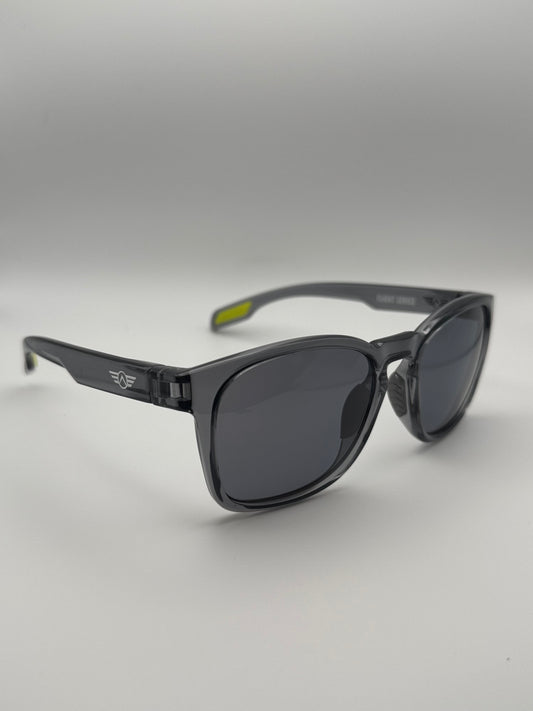
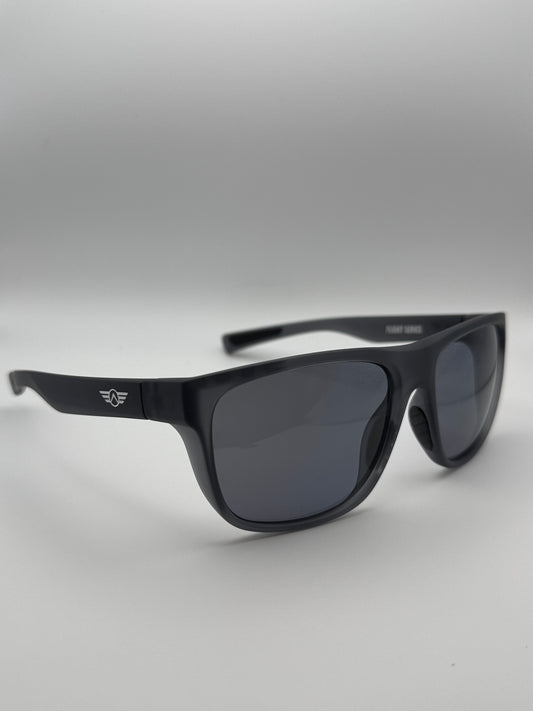
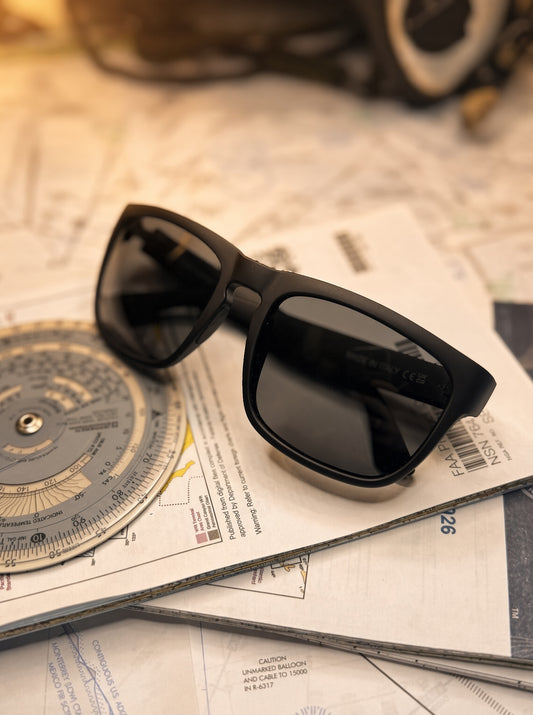
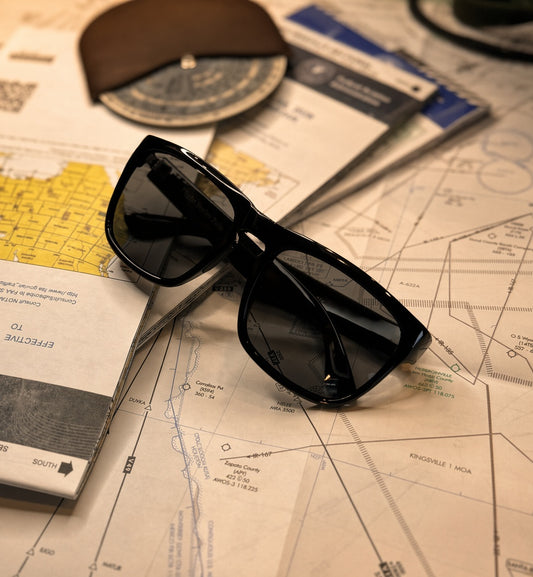
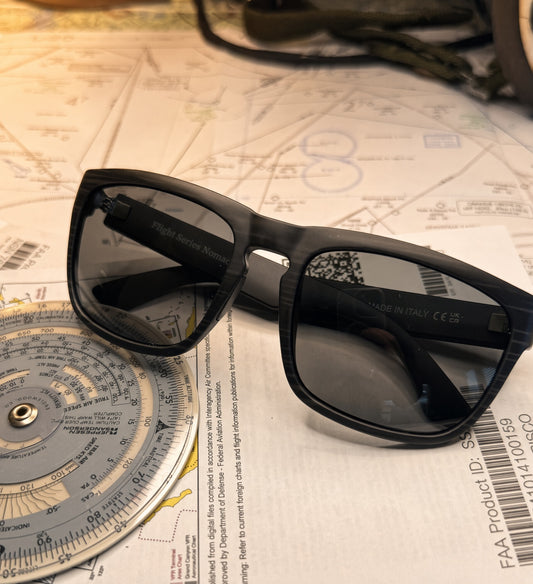
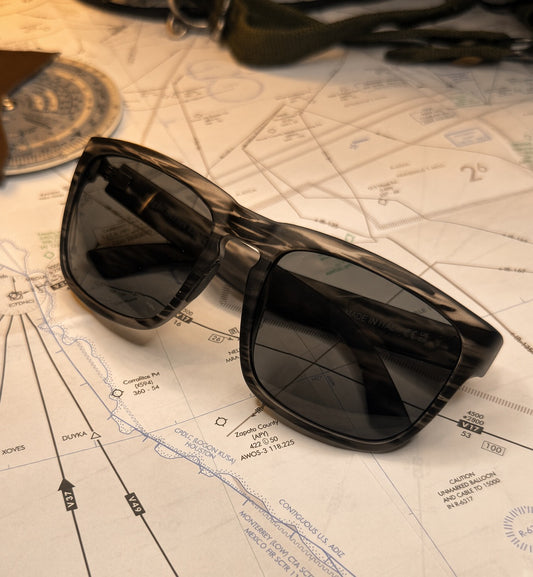
At Flight Series Eyewear, we design our sunglasses for pilots — built around the actual requirements of the cockpit environment, not the aesthetic of aviation. Every lens decision we make starts with what actually serves a pilot in the air. If you're tired of guessing whether your sunglasses are working for you or against you, that's exactly the problem we built this brand to solve.
Shop the Flight Series collection at flightserieseyewear.com.