The Best Sunglasses for New Pilots: What to Know Before You Buy

You've got your logbook, your headset, and your sectional charts. But before your next lesson or solo flight, there's one piece of gear most student pilots overlook until it's too late: sunglasses. Not just any sunglasses — the right sunglasses. The kind that protect your eyes at altitude, reduce fatigue on long cross-countries, and don't betray you the moment you glance down at your Multi-Function Display.

This guide is written specifically for new and student pilots who are figuring out what to look for, what to avoid, and why the pair of gas station shades in the cupholder of your Cessna isn't going to cut it.


Why Sunglasses Matter More in the Cockpit

At cruise altitude, UV radiation exposure is dramatically higher than on the ground. The atmosphere filters a significant portion of UVA and UVB radiation at sea level, but that protection decreases as you climb. Even in a low-altitude trainer at 3,000 feet, you're receiving more UV exposure per hour than someone sitting outside without eye protection.

Add to that the fact that pilots spend long hours facing directly into sunlight at varying angles, often above cloud layers that reflect and amplify glare, and you have a recipe for serious eye strain, headaches, and long-term cumulative UV damage.

The FAA doesn't mandate sunglasses, but every experienced aviator will tell you: proper eye protection isn't optional, it's part of your kit.


What Makes a Sunglass "Pilot Appropriate"?

Not all sunglasses are created equal. Here's what to look for when shopping as a pilot:

1. UV400 Protection

This is the baseline. UV400 means the lens blocks all light rays with wavelengths up to 400 nanometers — covering 100% of UVA and UVB radiation. Any pair of sunglasses marketed to pilots should have this. If a lens doesn't specify UV400, skip it.

2. Polarization (The Right Kind)

Here's where most new pilots get tripped up. Standard polarized sunglasses are designed to cut horizontal glare — great for driving or fishing, but potentially dangerous in a cockpit. Traditional polarized lenses can make Multi-Function Displays, LCD screens, and Heads-Up Displays appear dim, distorted, or completely blacked out depending on the viewing angle.

This happens because most digital cockpit screens emit light that is already polarized. When that meets the polarized filter in your lenses at a perpendicular angle, the light cancels out. The result is a screen you can barely read — or can't read at all.

The solution is MFD-compatible polarization — a lens engineered to reduce glare while remaining compatible with the polarized output of cockpit displays. This technology is what separates aviation-specific eyewear from everything else at the mall.

3. Impact Resistance

The cockpit is not a forgiving environment. Turbulence, debris, and the unexpected happen. Your sunglasses should be able to take a hit. Look for lenses rated to ANSI Z87.1 or built with polycarbonate or similar impact-resistant materials. Frames should be durable and flexible, not rigid plastic that shatters.

4. Frame Fit and Headset Compatibility

This one matters more than new pilots realize. Wide, bulky frames interfere with headset cushions and can create pressure points that become painful on a two-hour flight. Look for a slim profile that sits comfortably under over-ear headsets.

5. Lens Tint

Gray and green-gray tints are the most recommended for aviation. They reduce brightness without significantly distorting color perception — important when reading charts, interpreting weather, and identifying terrain. Avoid heavily colored tints (blue, rose, yellow) for primary flight use.


The Problem With "Pilot Sunglasses" From Generic Brands

Walk into any sporting goods store and you'll find dozens of pairs branded as "aviator-style" sunglasses. What you'll almost never find is a pair actually engineered for cockpit use. Standard polarization, fragile frames, and basic UV coatings are dressed up in a classic frame shape and marketed with a high price tag.

The irony is that the style known as "aviators" — the teardrop-shaped metal frame — was originally designed for military pilots in the 1930s. Over the decades it became a fashion staple. Today, most "aviator" sunglasses have nothing to do with actual aviation performance.

For a student pilot spending real money on training, it makes sense to invest in eyewear that's actually built for the environment you're flying in.


Our Top Picks for New Pilots: Flight Series Eyewear

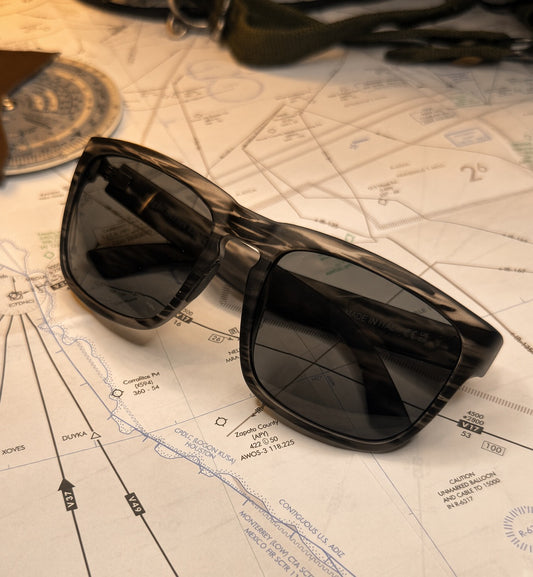
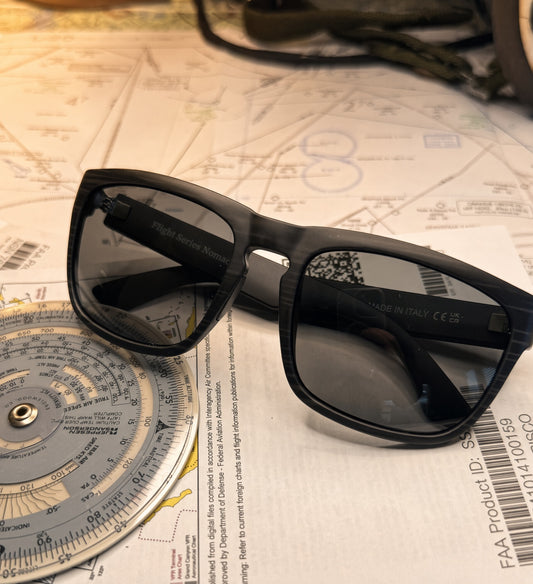
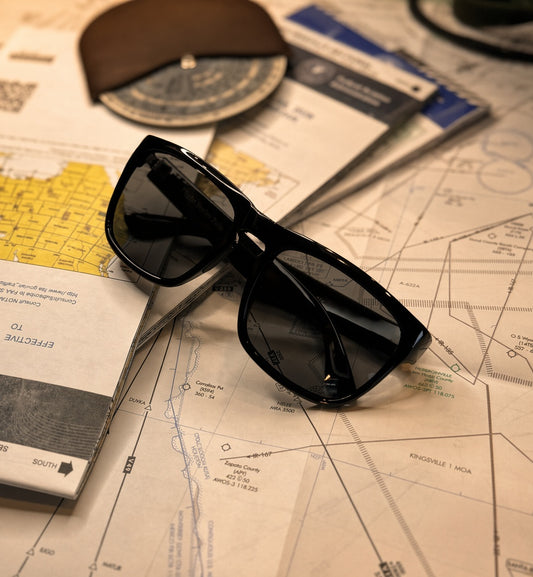
Flight Series Eyewear was developed by active-duty Naval Aviators who experienced the MFD blackout problem firsthand and set out to solve it. Every model is built with screen-compatible polarization, UV400 protection, and impact-resistant construction. Here's a breakdown of the models best suited to new pilots.


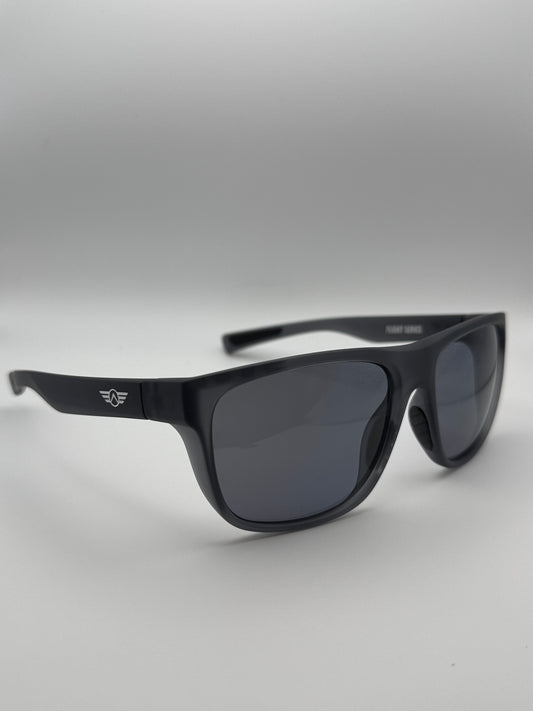
Best All-Around Pick: The Maverick

$79 — Shop the Maverick

The Maverick is the ideal starting point for student pilots. It's approachable in price, excellent in performance, and carries 16 verified 5-star reviews from real pilots.

The Maverick features:

  • MFD and HUD-compatible polarization that reduces glare without blacking out digital displays
  • UV400 protection blocking near 100% of UVA and UVB radiation
  • TR90 composite frame — a high-impact, flexible material that won't crack under stress and sits comfortably under your headset
  • Scratch-resistant and oleophobic (smudge-resistant) lens coating so your vision stays clear through the dirty, oily reality of a cockpit

For a student pilot heading into their first solo cross-country, or anyone transitioning to a glass cockpit for the first time, the Maverick is the move. You're not overpaying, and you're not compromising on the one feature that actually matters in an airplane: being able to read your screens.


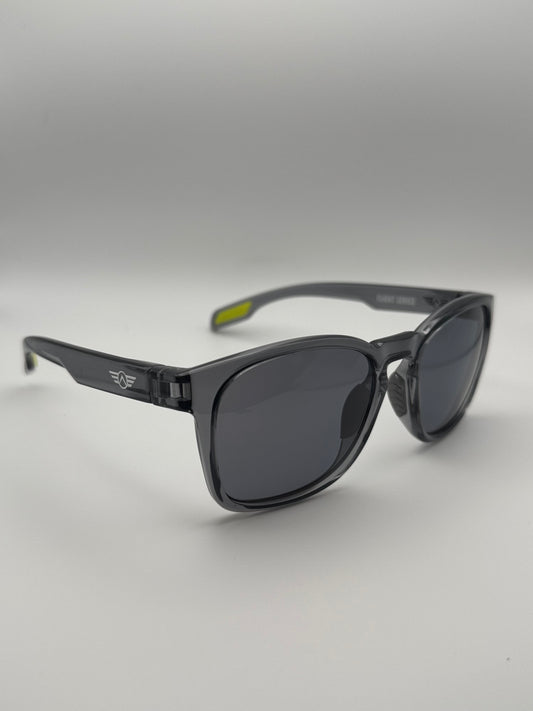
Best for a Second Pair or Style Preference: The Ghost

$79 — Shop the Ghost

The Ghost carries the same core technology as the Maverick — MFD-compatible polarization, UV400, TR90 frames, scratch and smudge resistance — in a different frame profile.

Why does this matter? Frame fit is surprisingly personal. The shape that sits perfectly on one pilot's face can create pressure points for another. Having a distinct style option at the same price point means you can choose the fit and look that works best for you without making any trade-offs on performance.

The Ghost has earned a 5.0 rating across 9 reviews and is popular with pilots who prefer a slightly different silhouette. If you've tried the Maverick and it's not quite your fit, or you just want to see both before deciding, the Ghost is worth a close look.


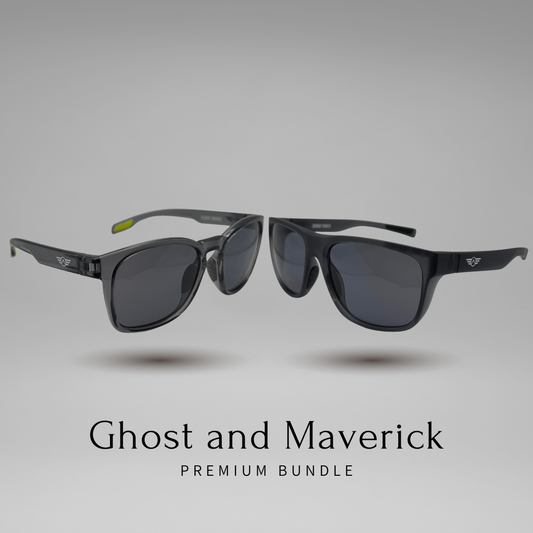
Best Value: The Pilot's Pair Bundle (Maverick + Ghost)

$129 — Shop the Bundle

Here's the case for owning two pairs: aviation is hard on gear. Lenses get scratched. Frames get bent. You leave a pair in the plane, or you lose one during a hot summer when you're moving between rentals. Having a backup isn't a luxury for a working pilot — it's practical.

The Pilot's Pair Bundle gives you both the Maverick and the Ghost for $129, saving you $29 versus buying them separately. You get two distinct frame styles, the full suite of protective technology on both pairs, and the peace of mind of a backup that's already qualified for the cockpit.

For student pilots who know they're going to be in the air consistently — whether renting aircraft at a flight school or working toward a private or instrument rating — this bundle is the smartest per-dollar investment in your kit.


Frequently Asked Questions: Sunglasses for New Pilots

Do I really need aviation-specific sunglasses, or will any polarized pair work?

Any polarized lens carries the risk of making MFDs and digital displays harder to read. If you're flying a steam-gauge Piper or a vintage aircraft with no digital instruments, standard polarized sunglasses may work fine. But the moment you're in a Garmin G1000, Dynon Skyview, or any modern glass cockpit, MFD-compatible polarization is essential. It's not a marketing claim — it's physics.

What lens color is best for flying?

Gray is the most widely recommended tint for pilots. It accurately renders colors without shifting the visual spectrum, which matters when you're reading charts, interpreting color-coded terrain on your MFD, or spotting traffic. Gray-green is also excellent. Avoid high-contrast colored tints for primary flying.

Can I wear contact lenses under sunglasses in the cockpit?

Yes. Contact lens use is permitted for pilots with an FAA medical. Contacts plus proper sunglasses are a common and effective combination.

Are mirrored lenses okay for pilots?

Mirror coatings are a surface finish, not a polarization type. A mirrored lens can still be MFD-compatible if the underlying polarization is engineered correctly. Focus on what's in the lens, not what's on the outside.

What about photochromic (transition) lenses?

Photochromic lenses darken in UV light — but aircraft windshields block a significant portion of UV, which means transition lenses may not darken adequately inside a cockpit. Most aviation medical guidance recommends against relying solely on photochromic lenses for flight.


The Bottom Line

Your first year of flying involves a lot of decisions, and sunglasses probably aren't the one you've spent the most time on. But the right pair makes a measurable difference — in how long your eyes hold up on a long VFR day, in whether you can read your MFD in direct sunlight, and in how you feel at the end of a three-leg cross-country.

The Maverick and Ghost from Flight Series Eyewear are built by pilots who flew with the same problem you're about to encounter, and solved it. At $79 each — or $129 for both in the Pilot's Pair Bundle — they're priced for student pilots, not just the warbirds crowd.

Fly safe. See clearly.


Flight Series Eyewear was developed by active-duty Naval Aviators to solve real cockpit problems. All sunglasses feature MFD-compatible polarization, UV400 protection, TR90 frames, and scratch/smudge-resistant coatings. Free shipping on all orders.

Shop the full collection →

Back to blog