The Path to Becoming a Marine Corps Officer and Aviator
Let’s skip the glossy recruitment brochures and Hollywood montages. If you think every military pilot grew up with aviation posters plastered on their bedroom walls and thousands of flight simulator hours logged by age sixteen, I’m here to tell you that’s simply not true.
My path to the cockpit was anything but typical.
In fact, when I first stepped onto the paved streets of Quantico, Virginia, I didn’t even know I wanted to fly. My focus was purely on becoming the best Marine ground officer I could be. But military life has a way of shifting your horizon when you least expect it.
If you are currently sitting in college, standing at a crossroads, or already marching through the woods of Officer Candidate School (OCS) wondering if aviation is your calling, let’s talk. As a former Marine Corps MV-22 Osprey pilot, I want to give you a straight-shot, mentorship-focused brief on how the path actually unfolds, why the "jet-or-nothing" mindset is a trap, and what it truly means to carry the double weight of the brass and the gold.
The TBS Pivot: Earning an Air Contract in the Dirt
Most aspiring aviators sign a guaranteed air contract before they ever leave for OCS. I didn’t. I arrived at The Basic School (TBS)—the six-month crucible where every newly commissioned Marine officer learns infantry tactics—with a ground MOS (Military Occupational Specialty) in my future.
But TBS changes you. You spend months living in the rain, navigating the dense, unforgiving woods of Camp Barrett, and executing platoon attacks. You gain an immense, lifelong respect for the ground Marine.
During one of those long, freezing field exercises, I looked up. I watched Marine aircraft operating overhead, working in perfect sync with our ground maneuvers. That’s when the spark caught. I didn’t just want to be on the ground; I wanted to be the tactical liferaft, the heavy transport, and the close-air support for the Marines holding the line in the dirt.
Securing an air contract at TBS is no walk in the park. It is a highly competitive, cutthroat process. You are competing against some of the sharpest peer minds in the country for a select few "ground-to-air" transition slots. To make the cut, you have to excel:
-
Military Aptitude: Your leadership evaluations from your TBS staff must be flawless.
-
Physical Fitness: You need a high first-class PFT (Physical Fitness Test) and CFT (Combat Fitness Test).
-
The ASTB: You must study in your rare off-hours, while physically exhausted, to crush the Aviation Selection Test Battery.
-
The Flight Physical: Your eyes and body must pass the stringent Navy aerospace medicine requirements.
When my competitive air contract was approved, it felt like winning the lottery. But the real work was only beginning.
Choosing the Osprey: Why I Said "No" to Jets
Once you complete NIFE (Naval Introductory Flight Evaluation) in Pensacola and head to Primary Flight Training (usually flying the T-6B Texan II at Whiting Field or Corpus Christi), the next big hurdle is "selection." This is the fork in the road where your grades, flight performance, and personal preferences dictate whether you go Jets, Helicopters, Multi-engine, or Tiltrotor.
There is a massive cultural assumption that every student pilot's ultimate dream is to fly single-seat tactical jets.
For me? I did not want jets at all.
Jets are incredible machines, but they operate at thirty thousand feet, screaming past a target at Mach 1.5. That wasn't the mission that spoke to me. I wanted to be close to the fight. I wanted to fly a platform that was intimately woven into the infantry’s daily operations.
That directed me straight to the MV-22B Osprey.
Selecting tiltrotors meant choosing the most versatile, technologically complex, and tactically vital machine in the Marine Corps inventory. The Osprey combines the vertical take-off and landing capabilities of a helicopter with the high-speed, long-range cruise performance of a twin-turboprop aircraft.
Learning to fly it is a masterclass in aerodynamics. One minute you are hovering like a helicopter, manipulating the nacelles to manage your relative wind; the next, you are transitioning those massive proprotors forward to fly wing-to-wing with traditional airplanes. It’s a dynamic, demanding, and incredibly rewarding envelope to operate in.
The Visual Crucible: Flying Tiltrotors
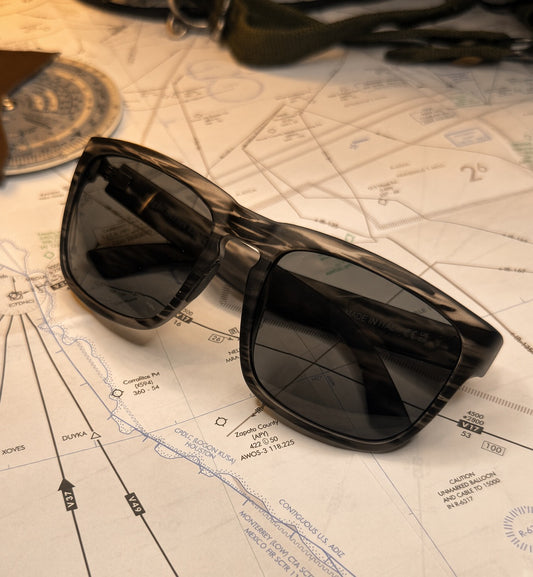
In the military aviation pipeline, your eyes are your life insurance policy. At Flight Series Eyewear, we often discuss visual clarity as a premium, but in the cockpit of an Osprey, it is non-negotiable.
When you fly tiltrotors, you are operating in the "dirt-level" environment. You aren't flying on autopilot above the clouds. You are practicing low-altitude tactics (LAT) at two hundred feet off the deck, navigating terrain, avoiding power lines, and managing rapid changes in ambient light.
The visual stressors of tiltrotor flying are immense:
-
The Glare Matrix: Transitioning from bright, high-altitude transits down into shadowed valleys or deep canyons requires rapid visual accommodation. High-altitude glare can cause extreme eye fatigue over a five-hour flight.
-
Night Vision Goggles (NVGs): Flying on NVGs is a core Marine competency. It reduces your field of view to forty degrees and strips away your depth perception. You must actively scan, relying on absolute visual focus and elite contrast sensitivity to spot obstacles in the pitch black.
-
The Dust and "Brownout" Threat: The downwash of an MV-22 is legendary. When you hover down into an unimproved landing zone in the desert, the ground turns into a swirling wall of dust, completely obliterating your visual references. You have to maintain your hover and land using instrument-guided drift control, scanning aggressively through the dust cloud for any hint of the horizon.
Without a doubt, having clean, undistorted, and reliable vision is just as critical as any instrument on your control panel.
The True Weight of the Shiny Rank
Here is the ultimate lesson they teach you at TBS, and one that is reinforced every day you spend in a fleet squadron: You are a Marine Officer first, and a pilot second.
When you check into your fleet squadron as a newly minted pilot with your "Wings of Gold," you don't just sit in the ready room waiting for your name to appear on the flight schedule. You are immediately handed a ground job. You might find yourself running the Safety department, managing squadron Logistics, or acting as the Maintenance Assistant.
You are put in charge of enlisted Marines—the sixteen-hour-a-day heroes who work in freezing cold or blistering heat to keep your Osprey flyable.
This is where the real challenge of being a military officer lies. It's not just about nailing a vertical landing on a moving ship deck at night; it's about leading a nineteen-year-old Marine who is tired, stressed, and homesick, and ensuring they have the support and resources they need to succeed.
You are responsible for their professional growth, their personal welfare, and their lives. When you sign the aircraft inspection sheet before a flight, you are trusting those Marines with your life—and when you take off with twenty-four combat-loaded infantrymen in the back of your cabin, they are trusting you with theirs.
That is the true weight of the brass. It is a profound, humbling responsibility that shapes you into a leader long after you take off the flight suit for the last time.
Mentor's Debrief: The Horizon is Yours
If there is one thing I want you to take away from my journey, it is this: Do not count yourself out before you even begin.
You do not need a lifelong master plan to become a Marine Corps pilot. You don't need to have a private pilot’s license in college. I was a ground-focused lieutenant at TBS when the sky finally called my name.
What you do need is an unshakeable work ethic, physical endurance, absolute mental flexibility, and a willingness to step up when a highly competitive opportunity presents itself.
Whether you end up leading infantrymen on the ground, flying supersonic jets, or pulling back the condition levers on an MV-22 Osprey to transition into vertical flight, the foundation remains the same: lead with integrity, keep your eyes locked on the horizon, and never compromise on your vision.